
About fifty years ago, a very young, very green, very inexperienced and totally naïve young man landed on Thursday Island in the Torres Strait, far to the north of Cairns in Queensland. It was my first teaching post – fresh out of university and Teachers’ College and soon to be set loose on the kids of Thursday Island – TI.
It is easy, now, to say I landed on TI.
In fact, I had endured a two-day train journey through a cyclone, and had been forced to survive on the dreaded Queensland Railway stale ham sandwiches, sandwiches that curled at the corners and challenged all but the bravest of souls … and the toughest of teeth.
It was just a short flight from Cairns to Horn Island – the local airport for TI – where my bags and I were tossed into the back of a dusty pickup truck, driven a few kilometres to a rough stone jetty, and downloaded into a World War II aluminium landing dinghy for the short journey from Horn Island to Thursday Island.
Welcome to the Grand Hotel
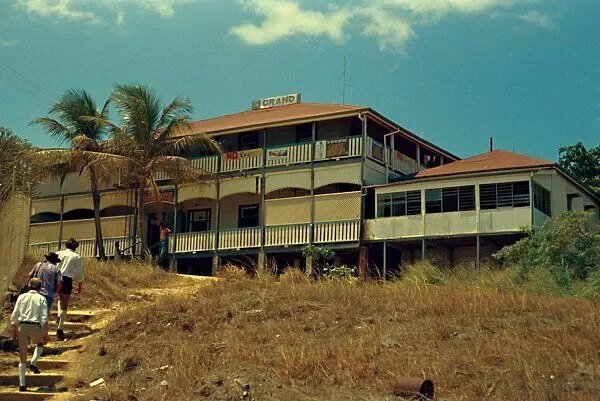
I dragged my bags up the dusty slope to the rickety steps leading up to the Grand Hotel, filled in whatever forms were required and trudged up the wobbling stairs to my room. The superb ocean views were breath-taking. The views between the loose floorboards into the public bar below our rooms were not.
Later that night I heard some sort of commotion and rushed out onto the dilapidated verandah to watch as two large – very large – Island women wrestled each other and punched each other and screamed at each other:
- You’ve been sleeping with my man!
- No – you been sleeping with MY man!
Boozers looked on from the steps of the hotel, cheerfully tossing encouraging beer bottles at the women with ribald cheers and casting bets on which woman would win the match …
It was an interesting – and challenging - introduction to the island where I spent a couple of years in the 1970s … and decided this year to go back to the island to see what had changed.
Fast forward fifty years …
Today’s Cairns airport is fresh, clean and modern, with lots of tempting food and wine options, clothing and book shops, and airline destination boards showing that flights were shortly to leave for places such as Waiben and Ngarupai – or Thursday Island and Horn Island in Colonial English. It is good to see that the heritage of the area is now being recognised.
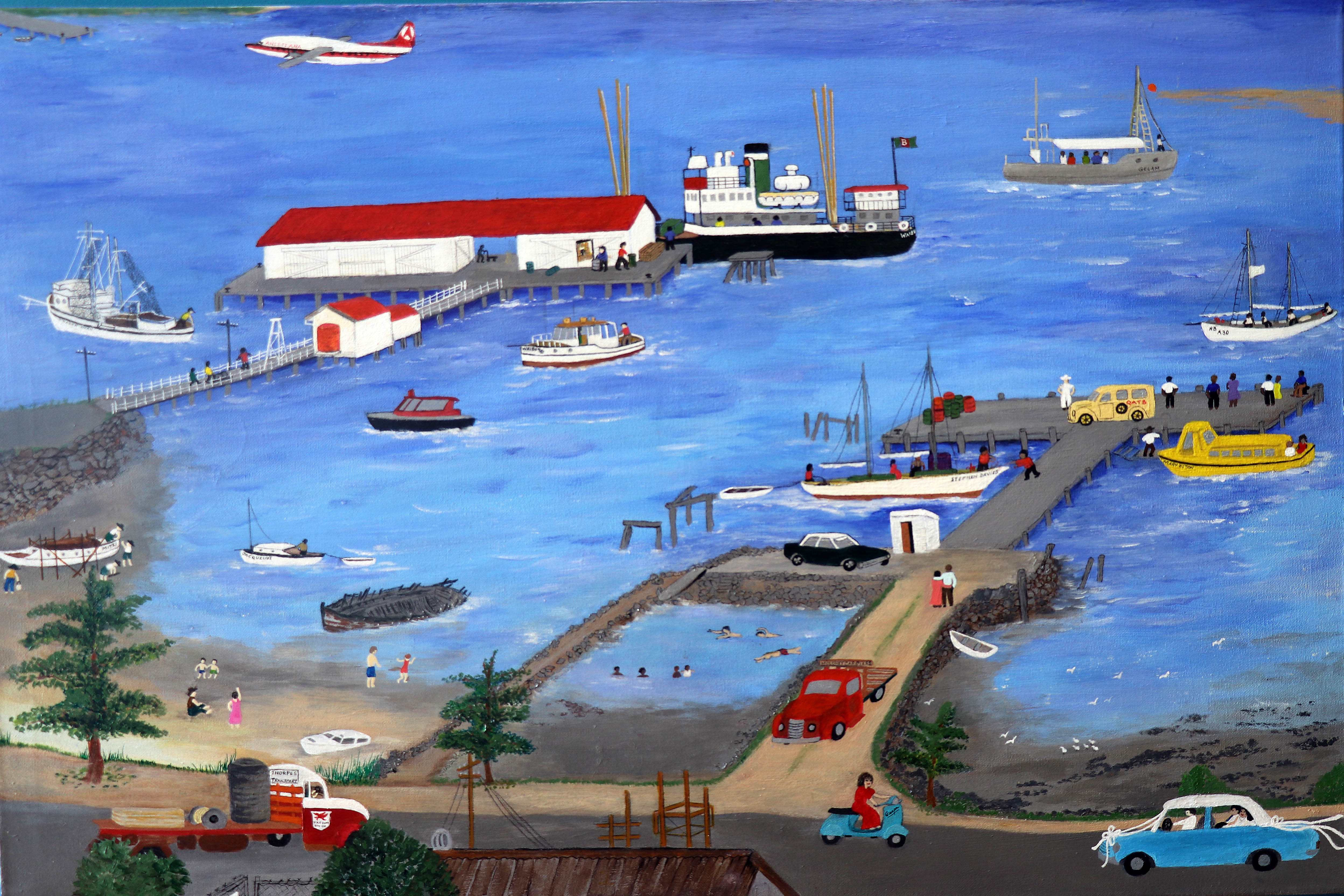
The modern Bombardier Dash 8 aeroplanes (replacing the old Fokker Friendships – see the plane in the painting above) seat about seventy people and fly to and from Horn Island most weekdays. They are met by an air-conditioned bus which takes travellers to an air-conditioned ferry for the short crossing to TI.
As travellers arrive at the new jetty, the Grand Hotel still stands proud – although it doesn’t, really. The original place, built in the late 1800s, burned down in the 1990s … and it is a remarkable feat that it lasted so long.


I found this painting in the reception area of the new Tagai College … and was pleasantly surprised to see the dirt path up to the school
and the kids on the barren square in front of the school that I recalled from all those years ago
The new Grand Hotel now greets visitors and there are air-conditioned rooms with en-suite bathrooms, there are no cracks in the floorboards and the downstairs bars feature a Bistro with tasty meals that are a long cry from the stale meat pies and tomato sauce I found half a century ago. And as an island hotel, prices are sky high. Each of the hotels and motels on TI charges about AU$260 per night … but the breakfast at the Grand was worth at least a good portion of that …
There are new roads all over the island (about five kilometres in total) and shopping options that would have staggered residents fifty years ago. The island is still only three and a half square kilometres in area – bigger than Monaco but much smaller than Liechtenstein.
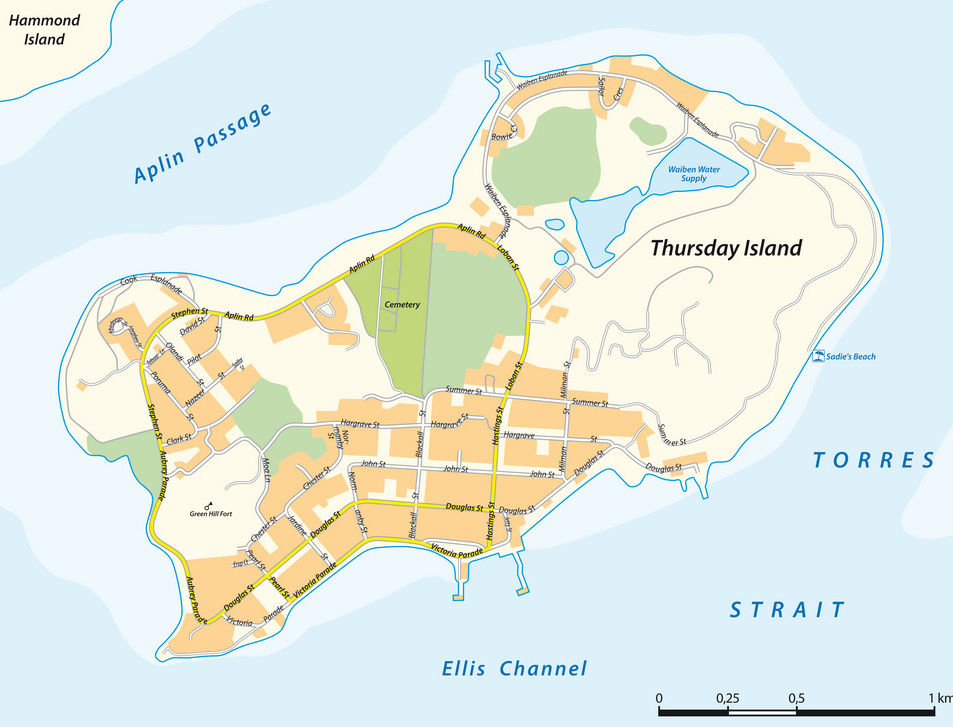
There are about 270 islands scattered between Cape York in Australia and the southern tip of Papua New Guinea, but only seventeen are inhabited. Thursday Island (with about 3000 residents) is the administrative centre for this vast area of 48,000 square kilometres.
The Bishop’s Boat
Many years ago, I travelled in the Bishop’s boat to the outer island of Mer – or Murray Island – home to about 450 people. It was an horrendous journey and I was violently seasick all the way there … and all the way back. Some of my then students had travelled to TI from Mer, and I wanted to say hello to their families … but I collapsed on the beach in a rather dishevelled state and did not meet the families.
(Can one ever be “hevelled” …?)
I mentioned this horrible journey to a woman I met on the ferry travelling to TI. She was quite surprised:
- You went there by boat …?
- Yes … How else would one get there …?
- By plane or helicopter of course …
How times have changed. There is no longer a Bishop of Carpentaria and several small aviation companies now zoom off to the outer islands. I spoke to staff at my former High School and found that the Head of the new Tagai State College regularly uses a helicopter to visit each of the seventeen schools now scattered across the Straits …

How I would have welcomed a helicopter all those years ago …
The Bishop – and the Cathedral Church of Carpentaria – were a huge part of life on TI fifty years ago. I had timed my visit this year to allow me to return to the Cathedral, its celebration of the Anglican eucharist, and its East / West two-part harmonies as the congregation sang hymns accompanied by a guitar and an island drum.
In the 1970s, the cathedral was packed with worshippers and one had to wrestle and tumble a matron or two to get a seat in a packed pew.
This year, I was one of eight in the congregation.
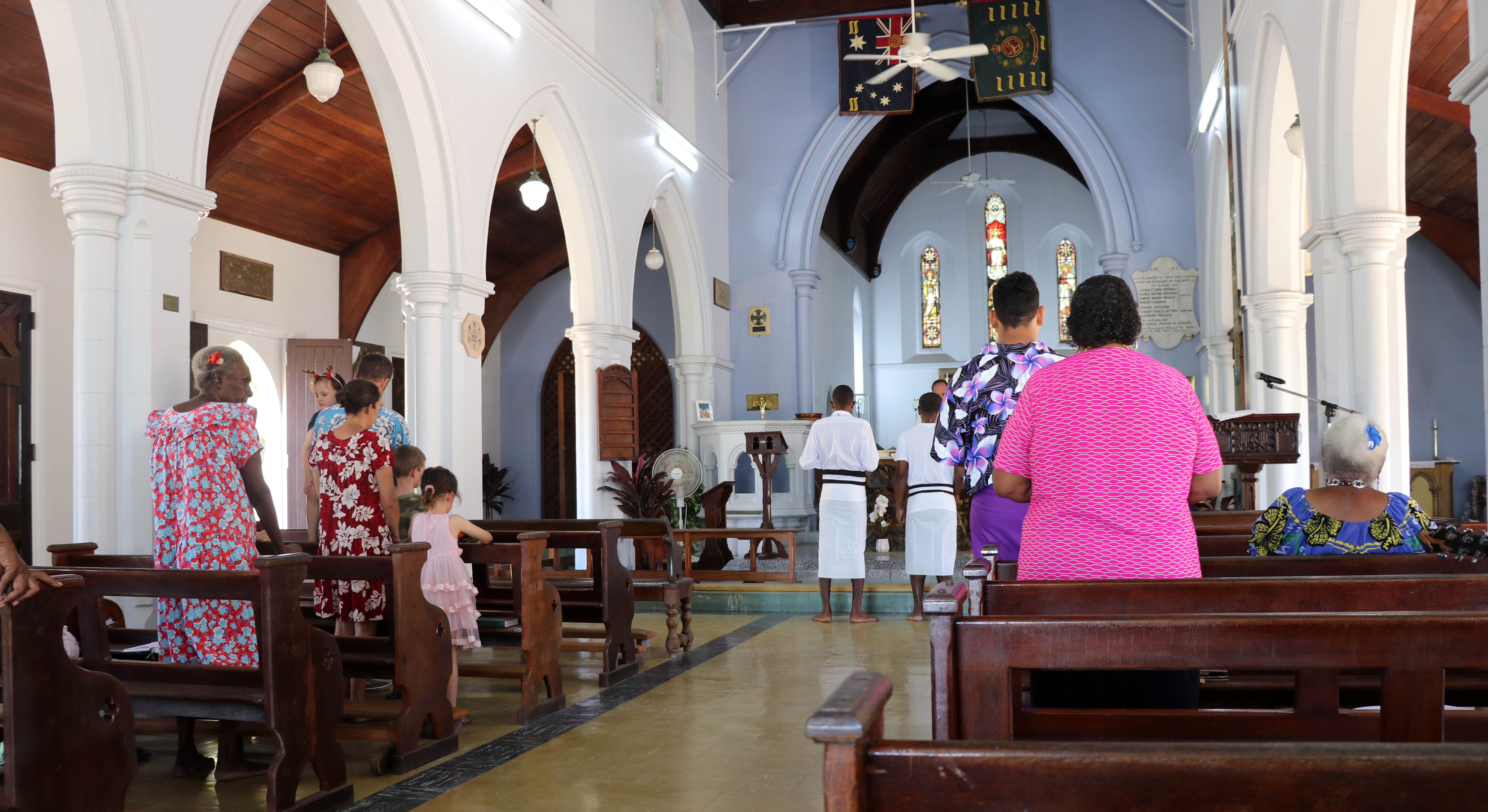
I now understand why the cathedral has been downgraded to a simple local church with a single priest, a few altar servers … but still the guitar and drum … and the bells and candles and incense I recall from before. This was my first visit to a church for Mass in over twenty years … and the simplicity and devotion of those very few participants may just have been enough for me to seek out my local parish church to renew my association with religion …
Modern TI
Years ago TI’s beaches were life-threatening – not so much because of nasty marine life such as stingers (box jellyfish) and sharks that still occasionally pop their heads up – but because of all the broken beer bottles, discarded condoms and washed-up plastic bottles. Today the beaches are spotless, and I saw numerous small family groups paddling the shallows and relaxing in submerged folding armchairs.
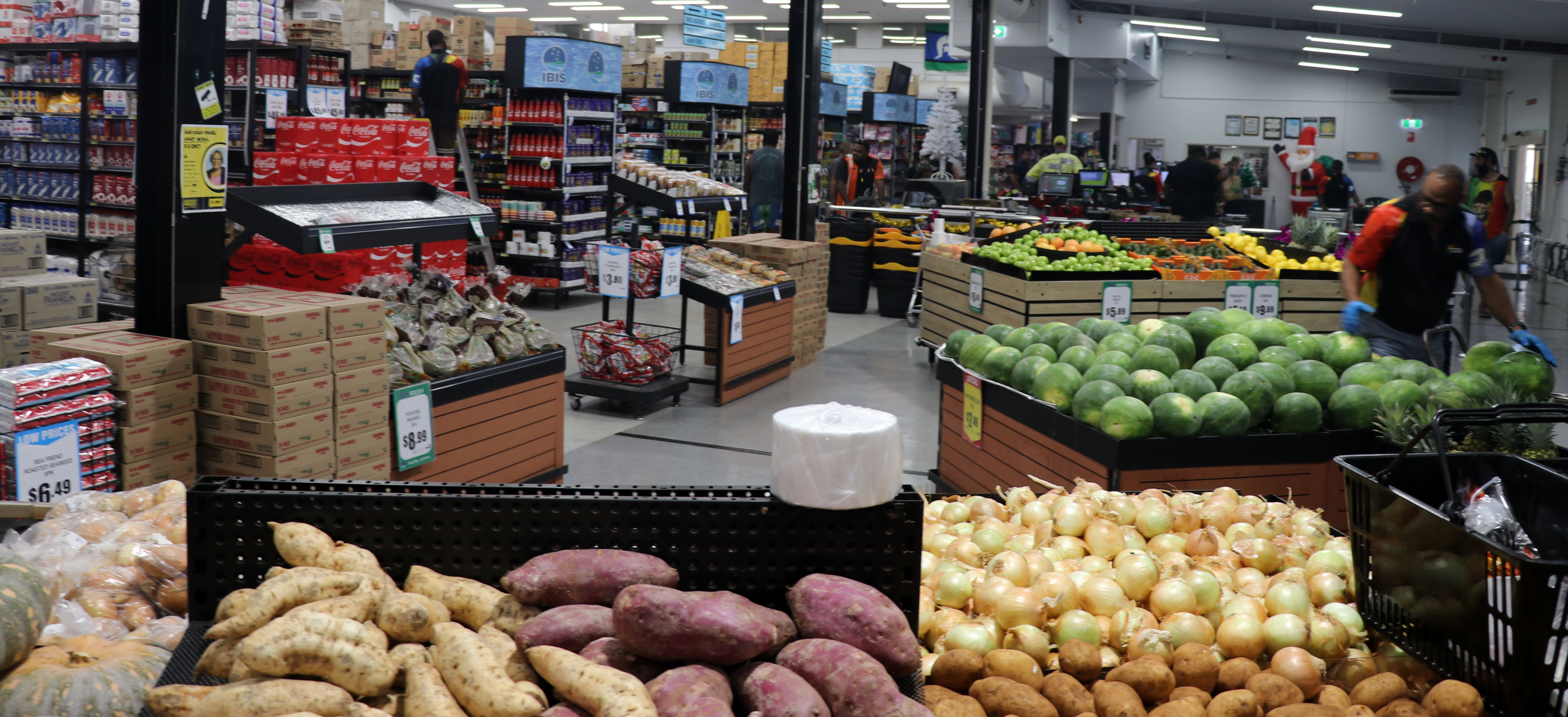
There are now three excellent supermarkets on TI, offering a range of fresh fruit and vegetables and meat comparable to any supermarket in a large mainland city. Several other large stores offer a range of clothing, giant flat-screen televisions and locally made souvenirs. There is even a huge Mitre 10 hardware store.


Douglas Street (the local “High Street”) and Victoria Esplanade along the foreshore now have comfortable shaded picnic tables and chairs. Modern sculptures dot the foreshore and a wide concrete jetty has replaced the old pier where visitors used to arrive. The old jetty had a rock-enclosed swimming pond – the only “safe” swimming spot on the island. Today an excellent sporting complex is situated just north of the State schools, and offers a fifty-metre swimming pool as well as two paddling pools for children, an air-conditioned gymnasium and an excellent covered basketball court with pull-out bleachers.
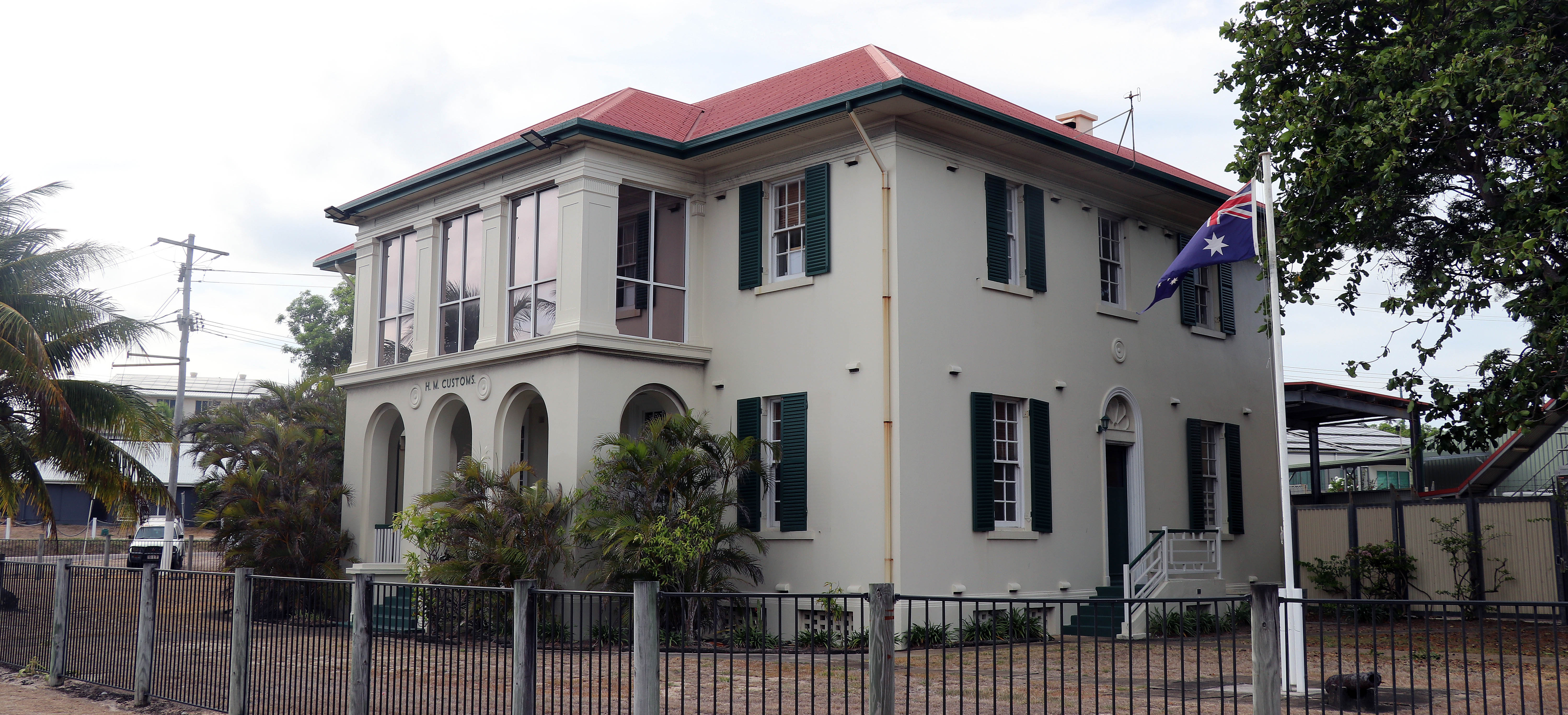
As TI is the administrative centre for a huge area, there are numerous government buildings in the town, and I was pleased to see a new addition to the island’s north-west coast: the Star of the Sea Elders’ Village. This huge complex offers single or shared rooms and great emphasis is placed on community and culture and language. All these new buildings on the island are nicely balanced by the original Customs House – a striking neo-Georgian building dating from the 1930s.
If music be the food of love …
As far as I can remember, there was no television on TI in the 1970s – and certainly no Internet. I think I can remember an indoor-outdoor cinema with low-slung canvas deck chairs downstairs under the stars, and slightly more comfortable chairs in the covered upper floor. It isn’t there any longer – and no longer are there the regular Saturday night “cabarets”.
At least two of the four pubs had cabarets every Saturday night, featuring local bands and often the famous Mills Sisters (later known as The Singing Grandmas) whose final number for the night was always Don’t Forget to Remember Me – the signal to finish off your last beer, kiss your partner of the evening goodbye, and to stagger off back to your home.
I called in to one pub this year and asked the bar staff if there were any cabarets offered. He (a young German man on a casual work visa) simply could not understand what I was talking about. The pubs today now have gaming machines, cable television and Internet – who needs a long slow song and a few shadowed smooches to finish off a busy week …?
Music is still an important part of life on TI and every second September there is the huge Winds of Zendath Cultural Festival. In July there is the Coming of the Light festival, which commemorates the arrival in 1871 of the first missionaries who brought “The Light of Christ” to the Torres Strait. Both festivals feature traditional dancing and music and lots of food … although in 1970 my first experience of the Coming of the Light was rather shattered by a sudden blackout … just as the actors playing the part of the first missionaries entered the cathedral grounds ….
- Hmm …
Then and Now (again)
The past and the present are very much a part of life on TI – then and now.

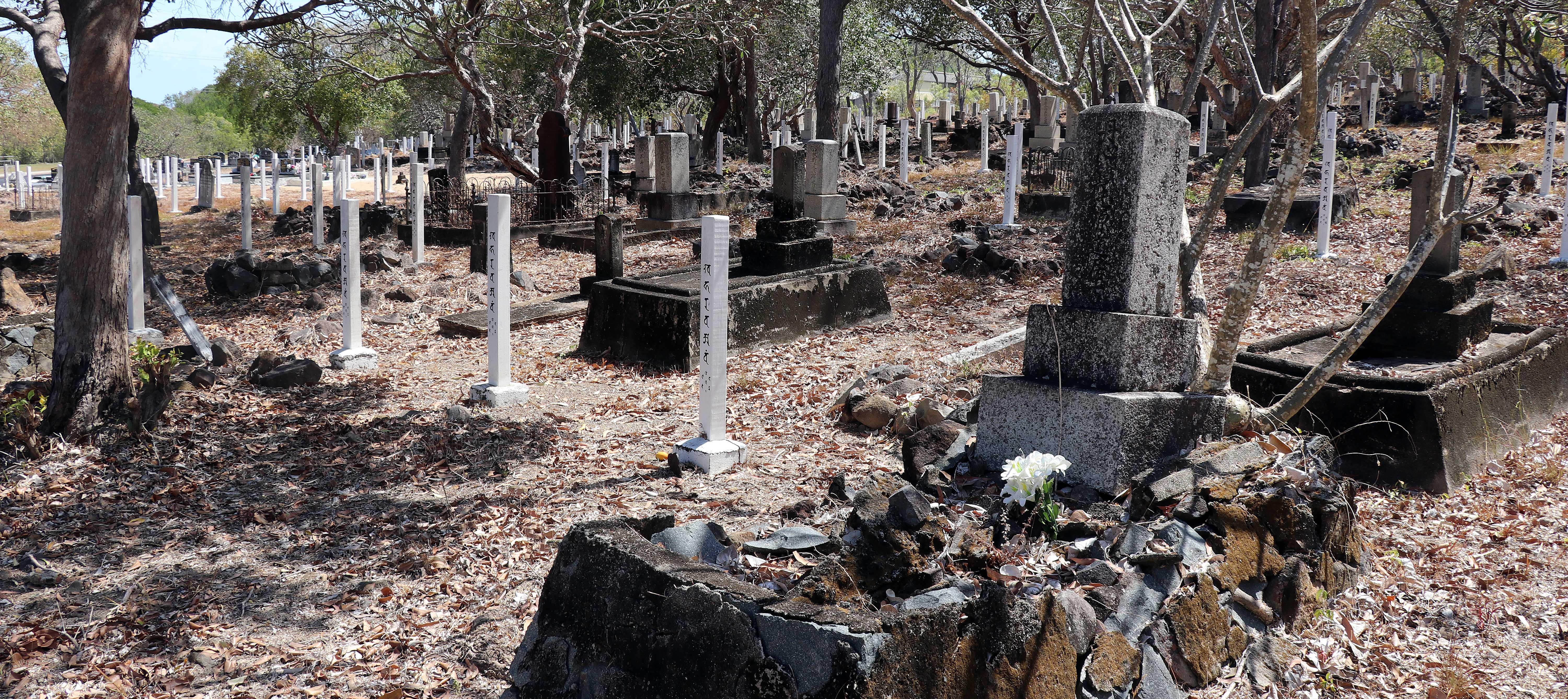
I arranged for a driver to take me to some of the areas I had visited so many years ago – but were today beyond my ancient legs. Brian – a charming and knowledgeable man who was a student at the school when I was there – took me to the old Japanese Cemetery after visiting Green Hill and last century’s huge gun emplacements there to frighten off the Russians … who never came.
The Japanese were a very important part of TI’s early life as the cultured pearl industry flourished. Unfortunately, the technology and medical knowledge of the day were far below today’s standards and there are numerous sad little graves of young men who died while engaged in pearl fishing.
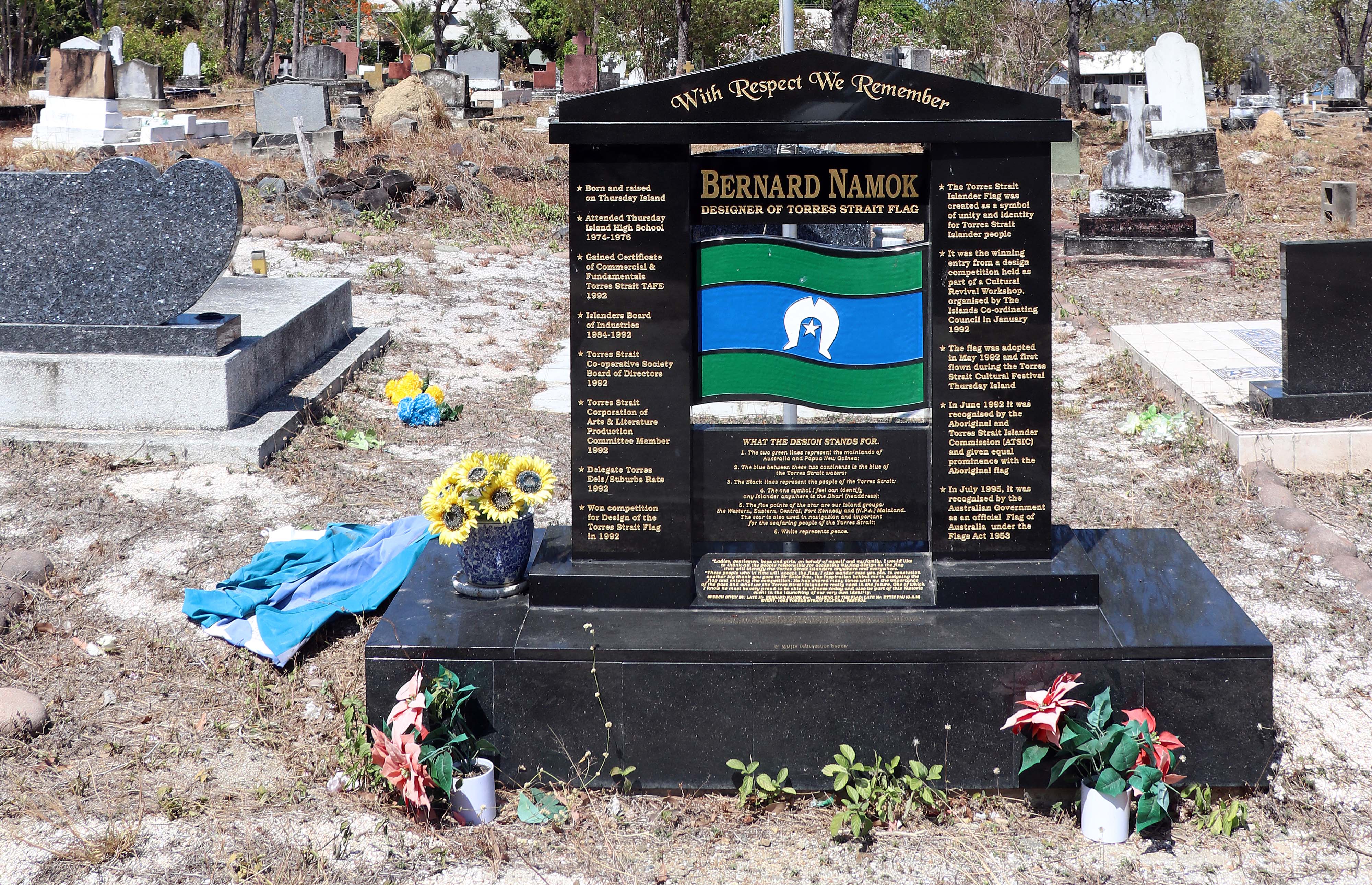
Adjacent to the Japanese Cemetery is the modern TI cemetery – with tombstones bearing the names of many families I knew … and the ornate tombstone for BM – a boy I did teach in the 1970s but who died in 2005. A nearby tombstone gives the details of Bernard Namok, who designed the flag recognised and adopted by the Australian government in 1992 as the official flag of the Torres Strait. This flag features the dhari or feathered headdress (see featured image, LEFT) worn on ceremonial occasions by men throughout the Strait, but particularly in the Eastern Island group.
Brian reminded me of the closeness of family in the Torres Strait where a man dying and leaving a widow is an opportunity for the families involved to take the widow into their home and care for her. A burial is always a sombre occasion – but a year or so later, there is usually a “Tombstone Opening” ceremony.
The grave site is decorated with flowers (plastic and live) and the ornate marble or granite tombstone the families may have been saving for is installed, giving the dates of birth and death of the dead person, and often his or her education and professional careers. A feast lasting several days may accompany the tombstone opening when delicacies such as dugong and sea turtle (banned to Westerners, but permitted to Islanders under a strict quota system) are served to those celebrating the life of their relative.
One feature of days gone by I could not find was the Rainbow Motel – formerly the most upmarket accommodation in the island and where a healthy meal could usually be found. I think the rooms are still there but the front part, where I used to have dinner, is now the Breeze In Vending shop, where water crackers, oat milk, Pad Thai noodles and Mi Goreng noodles, peanut butter, Fab soap powder, toilet paper, minced garlic and sliced beetroot can all be obtained by a simple swipe of a credit card …
Paradise Lost or Regained
I started this tale of travels to TI with a statement that I was then a terribly naïve young man.
On my more recent visit I went to the wonderful new Gab Titui Cultural Centre on the beautiful foreshore of the island where the 2023 Gab Titui Indigenous Art Award finalists’ works were on display: a wonderful collection of paintings, ceramics, collages and drawings.
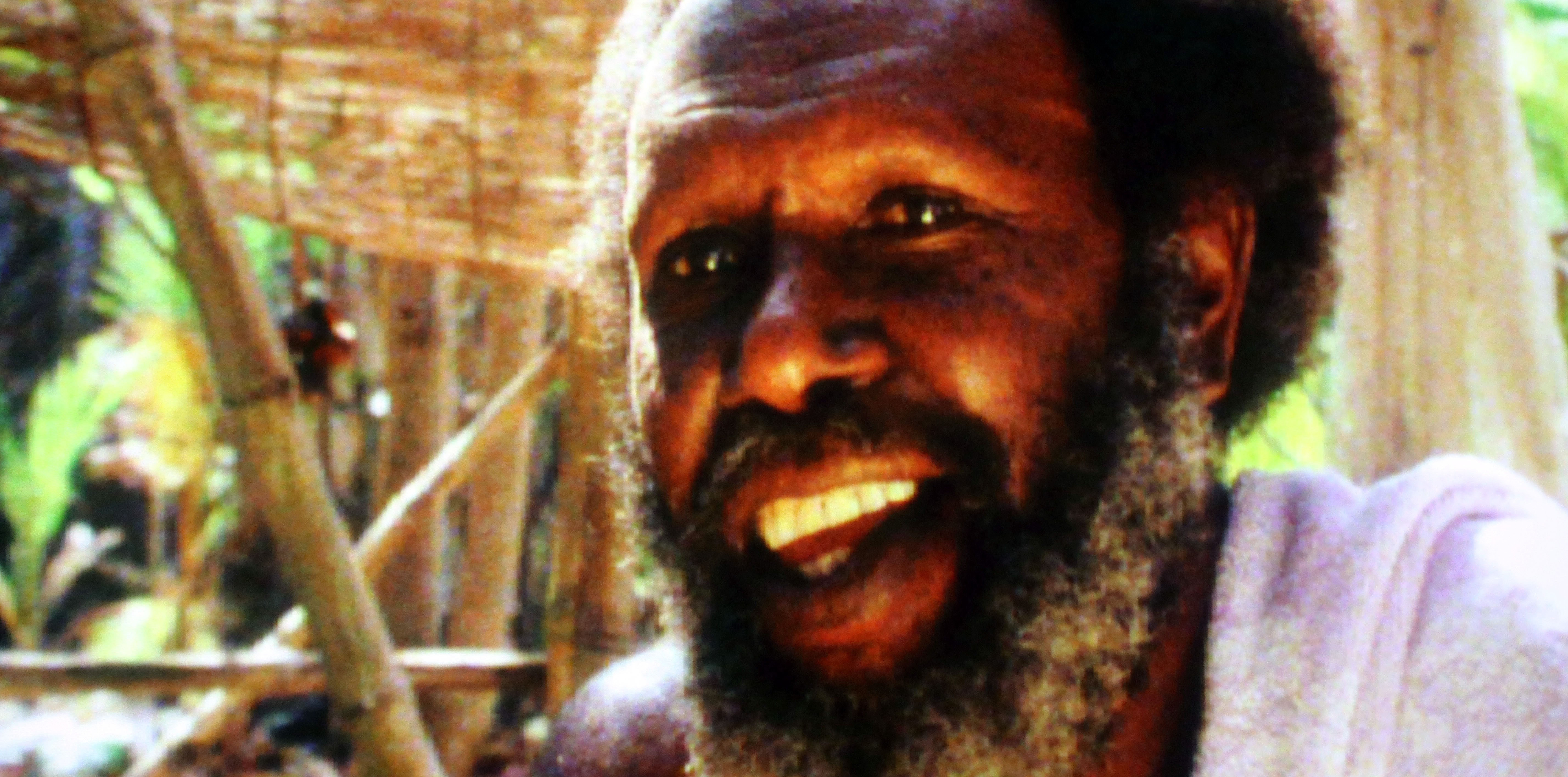
In an annexe to the exhibition there was a video screening of interesting bits of TI’s history – including the fabulous Mills Sisters’ story. Also featured were several videos of Eddie Mabo, an activist for Torres Strait and aboriginal land rights. One video stated that until quite recently, mainland aborigines and Torres Strait islanders were not included on the Australian census, but were regarded instead simply as part of the fauna and flora of the continent.
I was outraged to learn this but have since found that while Torres Strait people were probably not listed as “cattle” in early census data, it was not until 1967 – just five years before I first visited TI – that these humans were actually included in Australia’s census and were offered the chance to vote in State and Federal elections. In 1984 all Torres Strait people were required to register for voting – along with every other Australian. Torres Strait islanders were, in that year, finally accorded the same human rights as every other Australian.
In 1992 Australia’s High Court granted them ownership of their own land – a contradiction of the old “terra nullius” concept that erroneously gave the 18th Century invading Europeans the right to seize and govern the whole continent on the belief that it was simply uninhabited by humans. The 1993 Native Title Act later recognised Torres Strait islanders and mainland aborigines as Australia’s first peoples, and that their rights continued to exist despite European settlement.
Australia became a nation in 1901. It finally recognised its own people in 1993.
I am not sure if this later act was the regaining of paradise – or the creation of it.
Visit TI
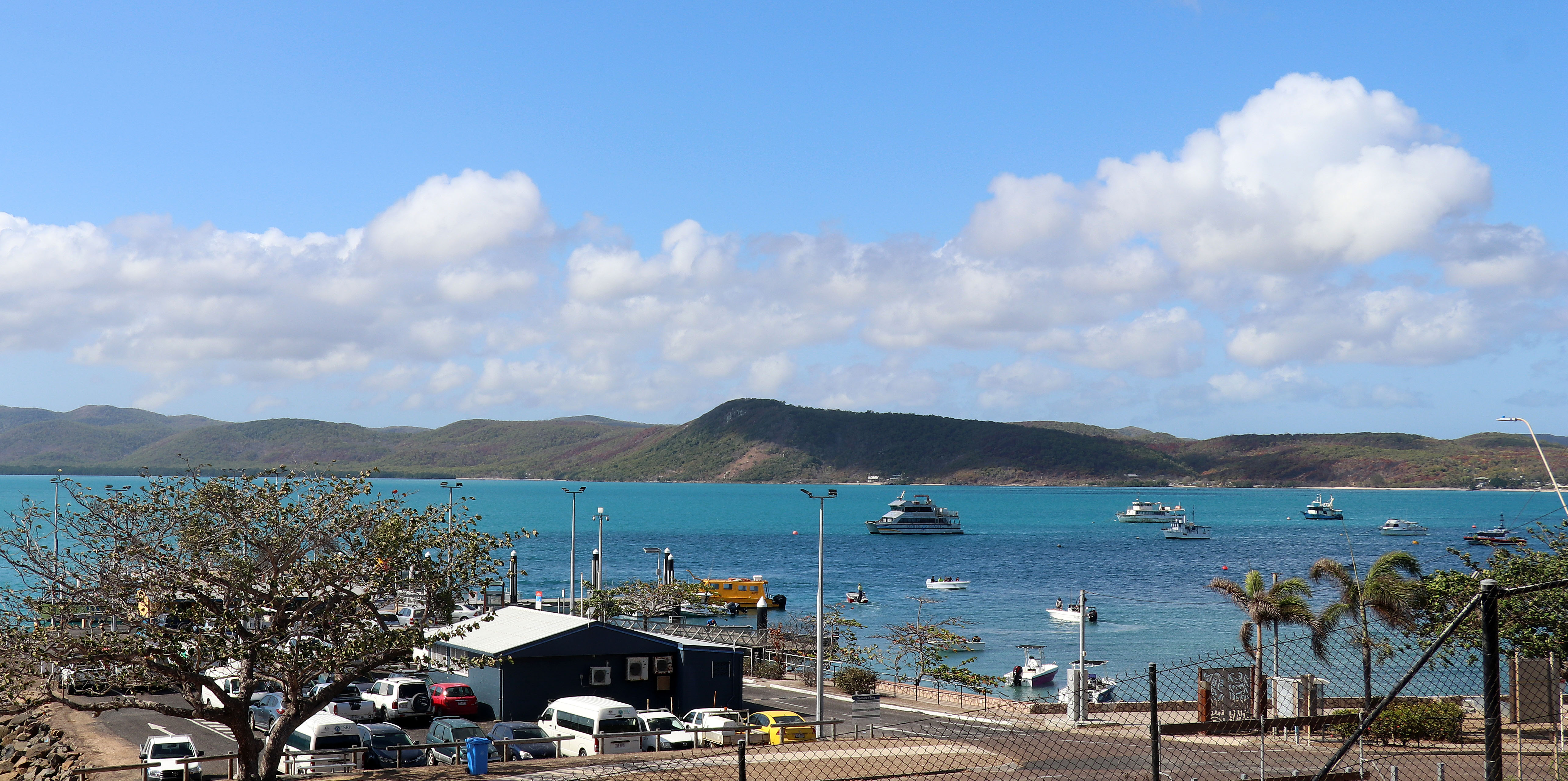
Thursday Island is not a beautiful tropical island and it is not Fiji or Hawaii. It is a tiny speck of dirt way up in the very far north of Queensland, but it has a rich history and it offers visitors a chance to learn so much more about this country’s heritage. It is not an easy place to get to and it is not a cheap place to visit when you get there, but if you are lucky enough to visit TI and to meet some of the local islanders – like my driver Brian – you will be richly rewarded.
……………………………………..
Journey November 2023
Text and photographs © Christopher Hall September 2023
Location maps, old Grand Hotel and featured image from the Internet
…………………………………….
If you enjoyed this story please scroll down to see earlier stories and forward the blog address to your friends: www.hallomega.com
If you would like to receive automatic notification of future postings on this blog please click the FOLLOW button on your screen.
……………………………………..
In my blogs I try to present a snapshot of the places I have discovered during a brief visit. I am not trying to present a detailed picture of the whole city or the whole region or the whole country.
……………………………………..
If a man ascended into heaven and gazed upon the whole workings of the universe and the beauty of the stars, the marvellous sight would give him no joy if he had to keep it to himself. And yet, if only there had been someone to describe the spectacle to, it would have filled him with delight.
- Attributed to Marcus Tullius Cicero – On Friendship
……………………………………..
 hallomega
Another wonderful and enjoyable travelogue, Chris. You have had an interesting life and made a great contribution to the lives of many others. Thanks for your friendship over the years – – Darcy T
LikeLike
Good afternoon Chris,
I have just spent a very nice 30 minutes reading about Thursday Island, looking up things you mention on the internet. It seems like a gem of a place to spend some time.
I have just returned to England, spending time with family and friends. As I get older I feel the need to be with the family, although not live with them!!! Having six grandchildren under seven years old, I know my limitations.
I have signed another contract to come back to Prem next year, I will be 73 in June but it doesn’t seem to bother anyone here, so I keep going. I really do love what I do and the kids, and November I had the opportunity to recruit in Myanmar and Korea. Like you, I am always happy to travel and see new places, I particularly liked Seoul.
I have Vicki come out to stay with me next Friday with her new ‘man’, well not really new, she has known him for 40 years but they got together about 3 years ago when he was on his own. She is arriving on International Day so that will be a bit of a bun fight. We changed it to a week day so that teachers would have an obligation with taking part – good luck with that one!
Chris, if you are ever back in Chiang Mai, please call, and if not keep these wonderful travel blogs going, I believe they make so many people happy.
Kind regards Linda.
Linda Buck*
Director of Boarding
[image: Prem e-mail signature-revised.png] https://ptis.ac.th/ [image: https://www.facebook.com/PTISschool%5D https://www.facebook.com/PTISschool [image: https://www.instagram.com/ptisschool%5D https://www.instagram.com/ptisschool [image: https://twitter.com/PTISschool%5D https://twitter.com/PTISschool [image: https://www.tiktok.com/@preminternationalschool%5D https://www.tiktok.com/@preminternationalschool
LikeLike